Kuro Games’ open-world action RPG didn’t just have a strong debut and disappear into the usual live-service cycle. By 2026, it has turned into one of the most talked-about gacha games on the market, which is exactly why so many players keep asking: why is Wuthering Waves so big? The short version is that it hit several key areas at once — combat that actually asks you to play well, a fast and steady update schedule, a monetization model that feels far less punishing than most rivals, and a post-apocalyptic style that gives it a real identity. Put those pieces together, and the game’s growth starts to make a lot more sense.
Why Is Wuthering Waves So Big in 2026
The numbers make the case pretty clearly. By early 2026, Wuthering Waves was sitting at around 280,000 to 300,000 daily active players worldwide, while Steam peak concurrent users regularly climbed to 25,000–30,000 whenever a major patch landed. On mobile, Version 3.1 turned February 2026 into the game’s second-biggest month ever, with AppMagic estimating roughly $46 million in revenue. That put it just behind Genshin Impact in the monthly gacha rankings, which is seriously impressive for a game still building its long-term position.
What really matters, though, is that these weren’t just one-off spikes. A lot of live-service games explode at launch, then settle into a much quieter maintenance phase. Wuthering Waves has done the opposite. When Version 3.0 launched in December 2025, it topped iOS revenue charts in multiple regions at the same time and also set a new all-time Steam concurrency record. That same pattern has kept showing up patch after patch, which tells us the momentum is built into the game’s structure, not just tied to launch hype.
Its platform spread helps a lot here too. On PC, the game has enough visual polish and technical quality to feel closer to a dedicated action RPG than a lightweight mobile-first title. On mobile, repeated optimization updates have steadily improved performance and lowered the hardware barrier. Because of that, Wuthering Waves has been able to pull in players across different regions, spending brackets, and device types in a way single-platform games simply can’t.
Wuthering Waves Combat and Exploration Pull
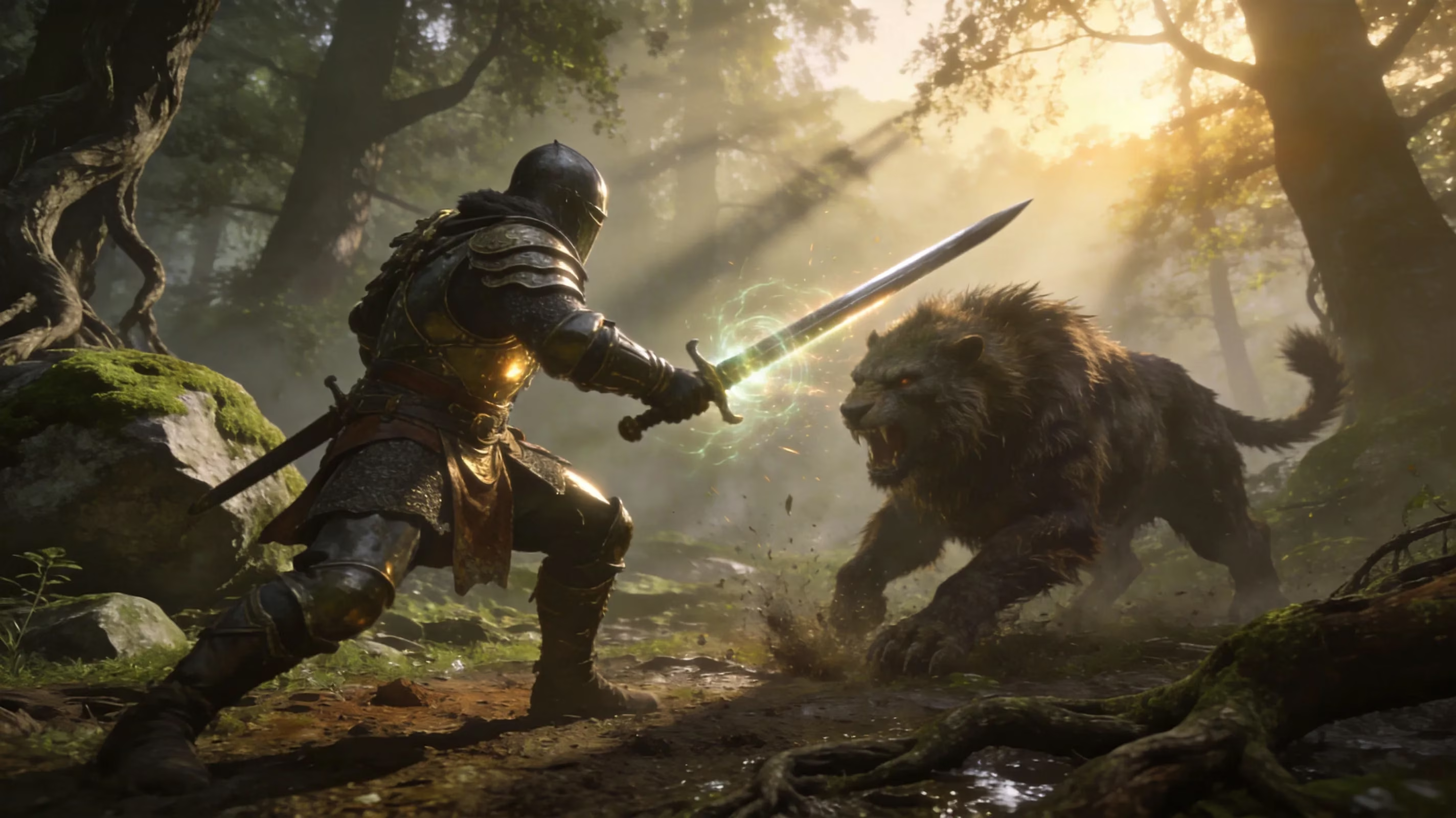
If you ask longtime players what keeps them around, combat is usually the first thing that comes up. Wuthering Waves doesn’t just reward raw stat stacking. It rewards timing, reactions, and clean execution. If you dodge too late, miss a parry, or fail to read an elite enemy correctly, you feel it immediately. That alone gives the game a very different kind of satisfaction compared to more rotation-heavy gacha systems.
The parry and perfect-dodge loop is a huge part of that appeal. Landing a clean parry interrupts incoming attacks and helps build Resonance Energy faster than a standard flow, so skilled play improves both survivability and damage output at the same time. Honestly, that feedback loop feels much closer to something like Sekiro or Devil May Cry than what most players expect from a gacha RPG. For people who got tired of passive combat systems, that difference is a massive retention hook.
Then there’s the Echo system, which adds another layer of player expression. Since Echoes let you equip monster-based abilities that interact with your Resonators’ kits, build crafting actually matters. A smart Echo setup can shift a character’s role, smooth out utility, or push damage in a more specialized direction. Recent patches also cleaned up a lot of the inventory pain through batch-processing improvements, so experimenting no longer feels like a chore. That matters a lot, especially for lower spenders trying to squeeze more value out of their roster without relying purely on banner luck.
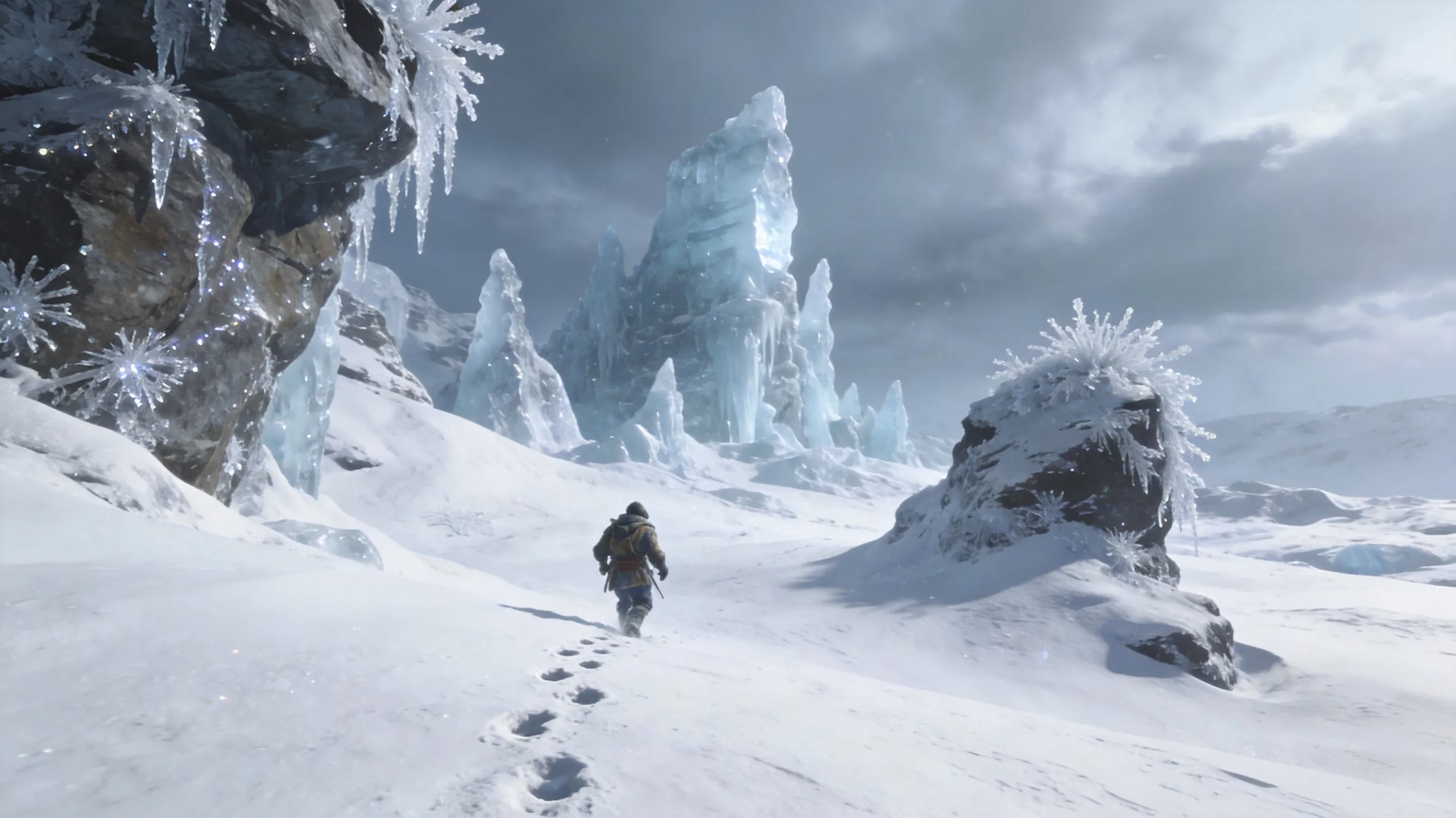
Exploration has improved in a big way too. Vertical movement was already one of the game’s strengths early on, but Version 3.0 pushed traversal much further with the expedition motorbike system. Suddenly, moving through the overworld felt faster, more dynamic, and just more fun. Players can boost, drift, and jump across terrain, and Version 3.1 even expanded that system to water traversal, which removed a lot of the dead space that used to break movement flow.
Wuthering Waves 3.0 to 3.2 Content Scale
A big reason why is Wuthering Waves so big became such a common question in 2026 is the sheer amount of content packed into Versions 3.0 through 3.2. Version 3.0, released on December 25, 2025, introduced Lahai-Roi, a subterranean city with its own biome near the Roya Frostlands. That update alone added more than 60 square kilometers of explorable space, spread across 15 ecological sub-regions, along with 30 new enemy types and 17 new Echoes.
| Version | Launch Date | Key Additions |
|---|---|---|
| 3.0 | December 25, 2025 | Lahai-Roi, motorbike system, 17 new Echoes |
| 3.1 | February 5, 2026 | Frostlands Surface sub-region, water traversal, Aemeath & Luuk Herssen |
| 3.2 | March 19, 2026 | Sigrika banner, continued Frostlands expansion, story arc continuation |
The story side was just as substantial. Versions 3.0 and 3.1 together delivered more than 10 hours of fresh cinematics and quest content. Kuro Games has been using a three-layer narrative approach — direct character communication, story-logic foreshadowing, and deeper thematic framing — and the Aemeath-focused material in Version 3.1 landed especially well with players. Across social platforms, the response was largely positive, with a lot of praise aimed at the emotional payoff and the stronger cinematic presentation. As of now, the Roya Frostlands map covers over 35 square kilometers, and more sub-region expansions are still planned.
The motorbike system also ended up doing more than just improving movement. It became a platform for collaborations too. Version 3.0 shipped with six free motorcycle skins tied to Sonic the Hedgehog and the Persona series, and a Cyberpunk: Edgerunners collaboration has already been confirmed for a later patch. Kuro’s roughly six-week patch cadence is a big deal here. The team describes it as “wave-like pacing,” and that’s a pretty accurate way to put it: enough time for players to actually finish what’s new, but not so much downtime that the game starts feeling stale.
Wuthering Waves Monetization and F2P Retention
A lot of Wuthering Waves’ staying power comes from how its gacha systems are structured. The Convene system is built around clarity in a way many players immediately notice. Hard pity is set at 80 pulls, so a five-star Resonator is guaranteed within that limit. Just as importantly, pity carries over between banners, which means your pulls never feel completely wasted if you decide to save or switch targets later.
The 50/50 system still adds uncertainty, of course. On a limited banner, your first five-star has a 50% chance to be a standard-pool Resonator instead of the featured one, which means the worst-case scenario stretches to 160 pulls across two cycles. But the game tracks that outcome explicitly and guarantees the featured unit on the next 50/50. That changes the whole mindset for free-to-play players. Instead of feeling like pure gambling, banner planning becomes something closer to resource management — still risky, but predictable enough to plan around.
Kuro Games backs that up with pretty generous reward distribution. Astrite comes from story progress, dailies, exploration, events, and compensation packages whenever bugs or downtime happen. Version 3.1 alone gave players up to 40 free pulls during its active period, plus the main character’s exclusive signature outfit and a free glider skin. That kind of reward density makes a real difference. If you log in consistently, even as a casual player, you can realistically save for specific banners without opening your wallet every patch.
That’s why spending in Wuthering Waves tends to feel optional rather than mandatory. If you want faster access to certain Resonators or you’re chasing Forte Resonance Chains, sure, spending helps. But the core experience and endgame access are not locked behind heavy payment pressure, and that lowers the frustration that usually pushes free-to-play players away.
Why Players Stick With Wuthering Waves
New players
One of the smartest additions in the 3.x era is the Express Routes system. It lets new accounts jump straight into Version 2.0 and Version 3.0 story content without clearing the entire earlier questline first. That solves a very real problem for players who were interested in the game but didn’t want to grind through a huge backlog just to catch up. On top of that, cross-platform onboarding is smooth, with progress syncing between PC and mobile. Version 3.1 also overhauled the loading pipeline to reduce stutter and improve data streaming on weaker hardware, which matters a lot in regions where lower-end or mid-range devices are still the norm.
Returning players
For returning Rovers, the re-entry point is much better now than it used to be. The Echo batch-processing update removed one of the game’s most annoying friction points — manually sorting and deleting piles of Echo inventory — while UI improvements made general navigation cleaner and faster. Version 3.1 brought strong rewards alongside its story content, and Version 3.2 kept momentum going with Sigrika’s banner. More importantly, the Lahai-Roi arc gives returning players a story payoff that actually feels worth coming back for, instead of making them feel punished for taking a break.

Wuthering Waves vs Other Gacha Giants
Comparing Wuthering Waves to giants like Genshin Impact and Honkai: Star Rail makes its appeal easier to understand. Those games are built around elemental reaction management, turn-based planning, or cooldown-driven rotations. Wuthering Waves goes in a different direction. It asks for real-time reactions and active decision-making in combat, which puts it much closer to traditional action game audiences than to the usual gacha crowd. That has helped it pull in players who like live-service progression but want something more hands-on.
Its tone also stands out. Most major gacha games lean into brighter palettes, lighter slice-of-life moments, or a more conventionally upbeat atmosphere. Wuthering Waves is darker, more muted, and more emotionally heavy, with a post-apocalyptic sci-fi identity that feels distinct rather than interchangeable. For a lot of players, that setting is not just background flavor — it’s one of the main reasons they stay invested.
Another area where Wuthering Waves has gained ground is update consistency. Kuro Games’ six-week cadence has done a lot to reduce the kind of content droughts that usually hurt retention in competing titles with longer patch cycles. Revenue reflects that momentum too. In February 2026, the game hit about $46 million in mobile revenue, trailing only Genshin Impact’s $54 million for that month. Around major updates, the gap has clearly been tightening.
That said, WuWa still has weak spots. Story pacing can feel uneven for players who care more about narrative clarity than combat systems, and the endgame challenge ecosystem is still not deep enough to fully occupy veterans between patches. The 50/50 system, even with its transparency, can also be intimidating for newer players who haven’t learned how to plan their pulls efficiently. Those are real issues. Still, the important part is that Kuro has shown a consistent habit of responding to feedback and iterating, instead of just treating existing systems as untouchable.
Conclusion
So, why is Wuthering Waves so big? Pretty much because it combines strong design with disciplined live-service execution in a way very few games manage to sustain after year two. Its combat rewards actual skill, its content pipeline keeps delivering meaningful expansions, and its monetization is transparent enough that players don’t constantly feel cornered by FOMO. That combination has created a game that grows between updates, not just during them.
If you’re wondering whether Wuthering Waves is still worth starting in 2026, the answer is yes. Express Routes make catching up much easier, cross-platform support keeps the barrier low, and the current Lahai-Roi arc is widely seen as some of the best writing the game has delivered so far. If you dropped the game earlier, the QoL changes alone — Echo cleanup, loading improvements, and motorbike traversal — make the experience noticeably smoother now. Wuthering Waves is at its best for players who want an action RPG that respects their time, rewards mechanical skill, and gives them a world that actually feels worth exploring. If that sounds like your kind of game, the Frostlands are still waiting.