The sea remembers every wave that has kissed its shores, and in the marrow of my console, I can still feel the pulse of a world that was once just a whisper in the static. It was July of 2024 when Kuro Games first cast that shimmering lure into the digital waters—a single, stunning image of the Rover looking out at a broken sky, accompanied by a promise that a PS5 version of Wuthering Waves was on the horizon. I remember staring at that announcement art, my heart doing a clumsy little somersault. A free-to-play open-world that promised combat with teeth, a world drenched in post-apocalyptic melancholy, and a protagonist who could absorb monsters without a gadget? Sign me up, I thought, and then waited. And waited. Boy, was I naive about how time can stretch when you’re yearning for something that hasn’t yet found its anchor.
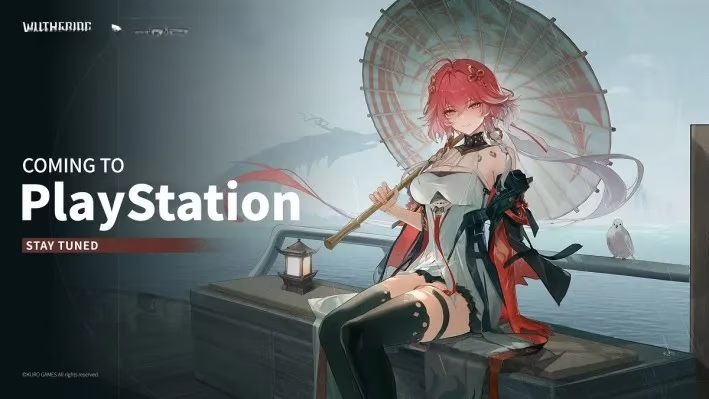
Now, in 2026, the disc sits inside my PS5 like a tide-smooth stone, still warm from the laughter and the late-night battles it has witnessed. The journey from that initial reveal to the moment my fingers finally curled around a DualSense controller, feeling every parry hum through the adaptive triggers, feels like a story the game itself would tell: of a shattered world slowly learning to resonate again. But I’m getting ahead of myself. Let me take you back, let me walk you through the echoes.
I was there when Wuthering Waves first washed onto PC and mobile devices back in May 2024. It was a chaotic, exhilarating mess. The game had a rocky launch, with translations that sometimes felt like they’d been chewed up by a Tacet Discord and spat back out, and enough bugs to fill a bestiary. Yet underneath all that noise, there was a rhythm. A rhythm of clashing blades that sang, of a vast, melancholy map called Solaris-3 that felt alive in its desolation. The Rover, an amnesiac with the singular gift of absorbing monstrous frequencies barehanded, became my conduit. No device needed, just sheer will. In those first, frantic days, the community swelled to over 30 million downloads in a month, a testament to the bone-deep pull of a world that punished as often as it rewarded. I loved it, but I always heard a ghostly call—what if I could experience this spectacle on a big screen, curled into my couch, with the lights off and the controller rumbling with every defeated foe?
The announcement of the PS5 version felt like the universe answering a half-formed prayer. But the silence that followed was, well, deafening. Months bled into a year. Kuro Games would drop cryptic breadcrumbs, a flash of new Resonator Changli’s fiery sword dance here, a whisper of optimization there. Changli, by the way, was a 5-star Fusion Sword character who strutted into the gacha pool shortly after that PS5 tease, and pulling her on mobile was an exercise in thumb cramps and squinty eyes. I kept picturing how her phoenix-like animations would look rendered in 4K, how the haptic feedback would translate the searing heat of her Forte Circuit. Friends would tease, “Still holding out for that console port? It’s already been out for ages, just play on PC!” But I’m stubborn. Some experiences, you just know, need a specific kind of altar.
Then, early last year, the tide finally turned. A PlayStation Store listing appeared, not just for the base game but with a cheeky pre-order bundle that mirrored what Zenless Zone Zero had done—a paid pack brimming with Astrites, shell credits, and enough level-up mats to make any rising Rover swoon. The game itself remained free-to-play, of course, but that bundle felt like a welcome mat, a knowing nod to those of us who’d been waiting with bated breath. The launch day, when it arrived, felt almost surreal. I can still recall the quiet hum of my console as the download bar filled, the same way the tide slowly erases footprints from the sand.
Oh, the first time I stepped into the lush overgrowth of Jinzhou on the PS5… It was like meeting an old friend who’d gone through a breathtaking transformation. The DualSense controller brought a whole new vocabulary to the experience. Every sprint, every wall-run, had a subtle, grounding resistance. The open-world exploration, already a joy, now felt tactile. When I entered my first combat encounter, the adaptive triggers fought back. A perfect dodge sent a sharp, satisfying click through my palms, while absorbing an echo—the game’s monster-capture mechanic—triggered a delicate, resonant vibration that seemed to travel all the way to my chest, a miniature thunderstorm of sensation. You know that feeling when a piece of art finally gets the frame it deserves? Exactly that.
And the world itself… Solaris-3 breathed in ways my PC monitor could never fully convey. The post-apocalyptic landscapes, rendered in HDR, were no longer just pretty backdrops but layered, living paintings. The sky, bruised with perpetual twilight, cast a glow that made the puddles on the crumbling asphalt look like liquid mercury. I spent an embarrassing amount of time just standing on a cliff, the wind from the soundscape rustling through the controller’s speaker, watching the distant, fragmented moon rise. It was as if the game had been holding its breath all along, waiting for this wider canvas to fully exhale its beauty.
Combat, the game’s pounding heart, turned into a ballet. The emphasis on speed and reaction chains felt tailor-made for the PS5’s responsiveness. I was no longer just tapping a screen or clicking a mouse; I was dancing with the Resonators. The Quickswap mechanic, where you effortlessly shift between characters mid-combo to unleash havoc, became an extension of my fingertips. There was a night, deep in the Illusive Realm, when I perfected a rotation between Jiyan’s dragon-spear charges and Yinlin’s electrifying puppet strings, and for a fleeting, golden moment, I wasn’t playing a game—I was conducting a symphony of destruction. No input lag, no disconnects, just pure, unadulterated flow. It felt so good I had to pause and just… sit with it for a second.
The gacha rhythm also felt more ritualistic on the console. Summoning on a banner was no longer a quick, furtive tap on a phone screen during a coffee break. It became an event. I’d dim the lights, let the opening notes of that ethereal summon music swell through my sound system, and feel the weight of each pull. When I finally pulled Changli, her blazing entrance in sweeping PS5-enhanced visuals and the controller’s intense vibration made the moment feel thunderous, almost sacred. Even losing a 50/50 to Lingyang had a tragic grandeur to it. The game’s roster has expanded beautifully since 2024, with new nations and fearsome Tacet Discords that require every ounce of skill the controller can summon, and I’ve loved every fragmented memory they’ve revealed about the Rover’s mysterious past.
There’s a quiet spot in the Central Plains, away from the chaotic tempests of the Tacet Fields, where I often let my Rover just stand and stare at the sky. The amnesiac with the power to absorb frequencies, a walking paradox in a shattered world. Playing on the PS5 has made those quiet moments deeper, more meditative. The console’s whisper-quiet operation means there’s nothing between me and the game’s haunting score. I think about how this version was once just hope and a JPEG, and now it’s a world I can step into from my couch, a world that hums back at me through the controller’s heart. It was a long tide to wait for, but every ripple was worth it. The waves didn’t just wuther; they finally came home.